Published on:
11 Aug 2025
3
min read
#notlegaladvice
#sustainability
The Law Society of Singapore
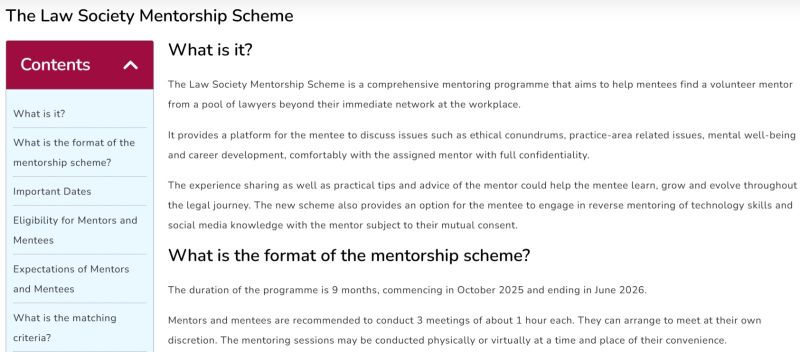
The Law Society of Singapore's Mentorship Scheme is embarking on its 3rd run, and applications are now open for mentees and mentors.¹
Much has already been said about how mentees can benefit from a mentorship program,² so I won't say much more about this.
Instead, this post is meant to encourage those who are considering signing up as mentors.
1️⃣ Some of you are interested, but are wondering if you have the time.
The good news is that the time commitment is a relatively manageable one. "The duration of the programme is 9 months... Mentors and mentees are recommended to conduct 3 meetings of about 1 hour each... The mentoring sessions may be conducted physically or virtually at a time and place of their convenience."³
That's an average of 20 minutes a month, or a single lunch slot once every 3 months. If you can't carve that out, then you probably have bigger issues to deal with.
2️⃣ Some of you are interested, but are wondering what's in it for you.
Everyone will have a different answer as to what they hope to get out of this. Some will conclude that they have no interest in anything that serving as a mentor can offer. That's fine! This is a voluntary scheme after all, and the Law Society is in no position to force sign-ups.⁴
Personally, I serve as a mentor because the mentorship experience places me in a position where I have to be honest and candid with my mentee. In doing so, I am forced to answer to myself as to why I do what I do, whether it is worth it, and whether my life choices need to be recalibrated.⁵
In a sense, a mentee's hard questions are one of my triggers for necessary self-reflection.
I will leave you to consider whether you think you can extract some value out of being a mentor, and whether such value, if any, is enough incentive for you to sign up.
3️⃣ Some of you are interested, but are wondering if you will be a good mentor.
Very good. The fact that you have this question is an indication that you might be a better mentor than most.
Because while I certainly hope that a mentor brings life experiences and wisdom to the table...
...I suggest that it is just as important, if not more important, for a mentor to bring a spirit of humility and wanting to understand.
I suggest that a good mentor isn't one who regurgitates their life story at every half-baked opportunity, expecting junior lawyers to fall on their knees with thankful tears of joy for the pearls of indescribable value falling from their lips.
Rather, it's someone who's willing to listen⁶, support⁷, and share⁸, in a brave space⁹.
And by asking this question, it tells me that you care about being a good mentor, and are more willing to put in the requisite work.
Which is as good a starting point as any.
Disclaimer:
The content of this article is intended for informational and educational purposes only and does not constitute legal advice.
¹ https://www.lawsociety.org.sg/the-law-society/support-schemes/mentorship/
² https://law-society-singapore-prod.s3.ap-southeast-1.amazonaws.com/2025/08/2025.08.12-Mentorship-Guidelines.pdf - there's lots of material in here for mentors as well.
³ And that's not to say that you're limited to this number of meetings if you do hit it off with your mentee. And if you want to guard your time, there's nothing wrong with setting boundaries at the outset - you are free to ask your mentee to, outside of these meetings, (a) contact you via email only; (b) WhatsApp you at any time with the caveat that you will take your time to reply; or (c) get in touch in a way that best fits your schedule.
⁴ And frankly, why would anyone want to? Pairing an enthusiastic and eager-to-learn mentee with an uninterested and disengaged "mentor" does the mentee a disservice, and potentially disillusions a mentee who is in need of guidance. If you need some mercenary reason to sign up for as a mentor, you may not be the right fit. Sorry not sorry!
⁵ https://www.khelvinxu.com/viewpoints/on-mentorship-and-the-massaging-of-egos
⁶ Because if a mentor doesn't listen, how can they even begin to understand what their mentees' needs are?
⁷ Support isn't the same as advice. It can come in the form of affirming choices that the mentee isn't sure about, offering a different angle for mentees to consider, or just acknowledging that the mentee is a person of worth.
⁸ Again, sharing isn't necessarily the same as advice. It's definitely not lecturing. It's about, perhaps, sharing a viewpoint or an experience that is relevant to the mentee, and not expecting the mentee to blindly follow, but using the sharing as a trigger for the mentee to come to their own conclusions.
⁹ "Safe space" is the more commonly used term, but I prefer "brave space", because it connotes efforts on the part of the mentee as well - to learn and grow even if it is uncomfortable to do so.