Published on:
29 Aug 2025
3
min read
#notlegaladvice
#workplace
The Straits Times.
I shared some thoughts with Sharon Salim of The Straits Times on work injury claims, and the Work Injury Compensation Act (WICA) regime versus civil Court claims.¹
--
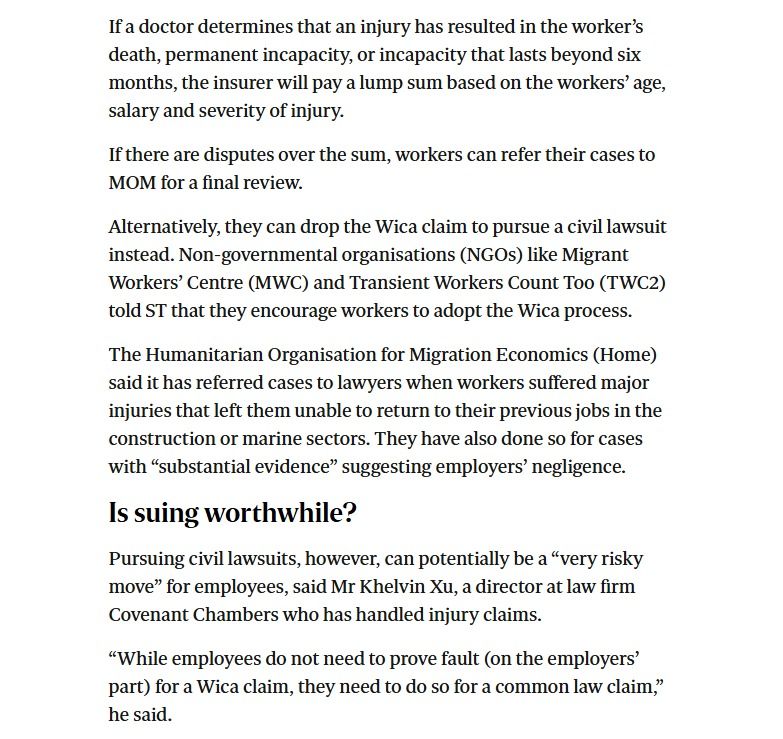
"Workers who are injured in the course of their work are entitled to compensation – even if the injury is due to their own carelessness. But exceptions apply... [T]he insurer will pay a lump sum based on the workers’ age, salary and severity of injury...
Alternatively, they can drop the Wica claim to pursue a civil lawsuit instead. Non-governmental organisations (NGOs) like Migrant Workers' Centre (MWC) and Transient Workers Count Too (TWC2) told ST that they encourage workers to adopt the Wica process.
The Humanitarian Organization for Migration Economics (Home) said it has referred cases to lawyers when workers suffered major injuries that left them unable to return to their previous jobs... They have also done so for cases with 'substantial evidence' suggesting employers’ negligence...
Pursuing civil lawsuits, however, can potentially be a 'very risky move' for employees, said Mr Khelvin Xu, a director at law firm Covenant Chambers who has handled injury claims.
'While employees do not need to prove fault (on the employers’ part) for a Wica claim, they need to do so for a common law claim,' he said."
--
So, to take an example, suppose:
(a) a light bulb blows in the office. My employer² instructs me to replace the bulb;
(b) I'm too lazy to find a proper ladder, so I climb onto a cabinet in an attempt to reach the ceiling lamp; and
(c) the cabinet topples,³ and I hurt my shoulder in the fall.
If I bring a WICA claim, I'm likely to get compensation. Never mind that my employer didn't asked me to clamber onto the cabinet. Never mind that this whole accident was substantially, if not entirely, my fault. The key feature of WICA is that it's a no-fault compensation regime.
But suppose I decide that the WICA payout isn't enough for me, and I want more compensation. I could then withdraw my WICA claim, and commence a claim in Court, since the Court can order compensation that exceeds the WICA claim limits. However, if I do this:
(a) my employer will now be free to argue that it is not liable because the accident was caused by my own carelessness. After all, employers are not obliged "to stand over workmen of age and experience at every moment they are working"⁴;
(b) I will have to incur more legal costs to bring a claim in Court; and
(c) if I am unsuccessful in my claim, not only do I have to pay my lawyers, I may also have to pay legal costs to my employer.
Which is why opting to bring a civil claim in Court can be risky for employees, who should first seek proper advice from a practicing lawyer.⁵
--
Many thanks as well to Sara Ng, for partnering with me regularly on such matters.
Disclaimer:
The content of this article is intended for informational and educational purposes only and does not constitute legal advice.
¹ https://www.straitstimes.com/business/accidents-for-payouts-how-common-are-workplace-injury-scams.
² Purely hypothetical, since I'm self-employed.
³ C'mon, you saw this coming a mile off.
⁴ Parno v SC Marine Pte Ltd [1999] 3 SLR(R) 377 at [46].
⁵ Not a friend of a friend. Not someone who claims that they have successfully sued their employer for a huge payout. Not even somebody who "works at a law firm". An actual practicing lawyer.⁶
And yes, I'm biased. Sorry not sorry.
⁶ If you're not sure about the credentials of the person you are speaking with, please do a search on the Ministry of Law, Singapore's website: https://eservices.mlaw.gov.sg/lsra/search-lawyer-or-law-firm/.